

Korean Racing Data
What Do S1F and G3F Mean in Korean Horse Racing?
A practical guide to S1F and G3F sectional times in Korean horse racing, including definitions, comparisons and common mistakes.

In Korean race results, S1F describes the first 200 metres after the start, while G3F helps you read the final 600 metres before the finish. They are useful clues to early positioning and finishing speed, but neither number predicts the next result on its own.
S1F: the opening 200 metres
The Korea Racing Authority defines the S1F point as 200 metres from the start. F stands for furlong; Korean result tables treat one furlong as 200 metres.
A shorter individual S1F time means the horse covered the opening 200 metres faster. It can indicate early speed, yet gate position, break quality, nearby runners and jockey tactics all affect the figure. One fast S1F does not automatically make a horse a consistent front-runner.
G3F: the final 600 metres
In G3F, G refers to the goal and 3F to three furlongs, or 600 metres. The KRA defines the G3F point as 600 metres before the finish; individual G3F figures are commonly used to read how quickly a horse covered that final section.
A shorter G3F can indicate a faster finish. Context still matters: a horse that conserved energy behind runners had a different trip from one that led into the wind.
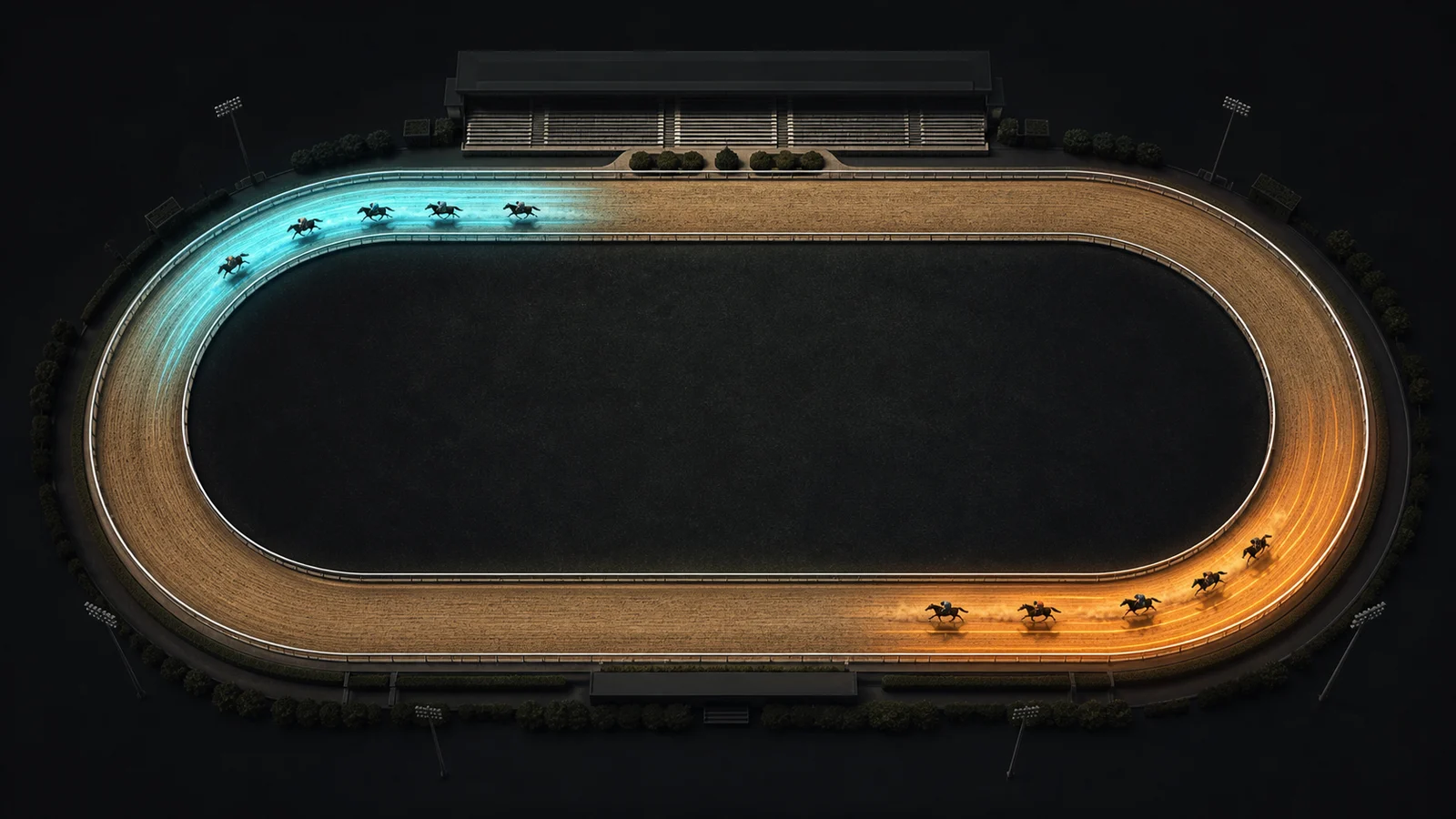
Original Malgorithm artwork: cyan represents the opening acceleration and amber the final 600 metres.
S1F versus G3F
| Figure | Section | Main question | Important caveat |
|---|---|---|---|
| S1F | First 200m | How quickly did the horse establish position? | Break and gate can distort it |
| G3F | Final 600m | How quickly did the horse finish? | Early pace and racing room matter |
Read together, the figures reveal more of the race shape: a runner may show speed and sustain it, spend too much early, or settle before producing a late run.
Compare like with like
An S1F of 13.8 seconds is not automatically “better” than 14.1. Check distance, track condition and moisture, carried weight, race class, opposition and sectional position. The safest first comparison is the same horse over a similar distance and surface condition.
Four useful patterns
- Fast S1F + fast G3F: early position and sustained finishing ability may both be present.
- Fast S1F + slower G3F: the horse may have spent too much energy early or faced a strong pace.
- Slower S1F + fast G3F: a clue to a late-running profile.
- Slower S1F + slower G3F: check the break, condition, distance suitability and trip.
These are observation frameworks, not prediction formulas.
Frequently asked questions
Is the fastest S1F horse always a front-runner?
No. Look for repeated early speed and forward positions across several comparable races.
Does a fast G3F always mean a strong finisher?
No. Early pace, traffic, distance and surface can make the same time mean different things.
Can I compare figures over different distances?
Use caution. Prioritise same-distance records and account separately for how a distance change alters pace.
Takeaway
S1F explains the opening 200 metres; G3F illuminates the final 600. They become meaningful when viewed with distance, surface, weight, class and race shape. Malgorithm organises these public records for comparison, but data supports judgement—it does not guarantee race outcomes.
Informational content based on public data. It does not guarantee race outcomes or profit.